Barbie: why an existential crisis looks better in pink
Greta Gerwig’s Barbie uses a perfect-looking world to ask what happens when perfection stops feeling like enough.
A perfect day starts to wobble
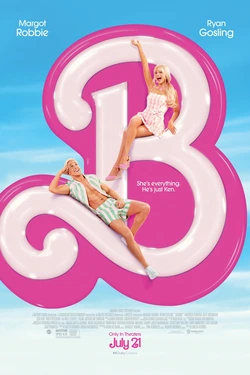
The official Barbie film synopsis offers a wonderfully efficient problem: Barbie Land is a perfect place, unless you are having a full-on existential crisis—or you are Ken. That joke contains the engine of Greta Gerwig’s 2023 film. A world built to appear effortless becomes interesting the moment a character notices effort, uncertainty and the possibility that perfection may be a very small room painted a very cheerful colour.
Pink is not an apology here. It is part of the argument. The visual world announces a familiar idea of play, aspiration and manufactured happiness, then invites viewers to ask who benefits from that idea and who finds it restrictive. A film can be bright and still ask uncomfortable questions. In fact, the brightness can make the discomfort sharper. When everything looks immaculate, one odd thought has nowhere to hide.
The joke has a serious job
Comedy lets a story approach a big subject without holding up a sign that reads “IMPORTANT THEME APPROACHING.” Barbie’s premise makes room for absurdity because the setting itself is artificial and aware of it. A joke about a doll’s world can carry a question about identity, expectations or the gap between being looked at and being understood. That does not mean every gag must be decoded like a secret message. Some jokes are funny because they are funny. The film gains energy when it can do both.
Ken’s place in the premise is especially useful. A world that centres one kind of identity will leave somebody else looking for a role. His insecurity can be comic and revealing at once. The story becomes more interesting when it lets both characters confront who they are without asking the audience to imagine that one neat speech will solve a lifetime of social expectations. A plastic universe may be simple to build; people remain inconveniently complicated.
The film’s enormous cultural conversation can make it difficult to talk about the actual work. One person sees a clever comedy, another sees an argument, a third sees a marketing phenomenon that arrived in their feed wearing pink for a month. Those responses can overlap. A branded property can become a thoughtful film, and a thoughtful film can also be sold with impressive corporate enthusiasm. The tension is worth discussing rather than pretending one side of it cancels the other.
Beyond the colour palette
The useful question is what the design does for the story. A perfect-looking environment creates a standard the characters must either meet or challenge. Costumes, sets and colour make that standard visible. When the emotional question deepens, the surface remains bright enough to remind us what the character is trying to move beyond. Style is not a decorative extra. It gives abstract ideas a room, a wardrobe and a surprisingly complicated front door.
This is analysis of the film’s premise and themes, not a first-hand scored review. The demo star rating has been removed pending an editorial screening. What remains compelling is the contrast: an apparently uncomplicated toy world can hold a story about self-definition, discomfort and the freedom to be less than perfect. That is a lot for a film whose colour scheme once threatened to turn every shop window into a themed birthday party. The pink did its job. The questions are why we are still talking about it.
One more thought
A useful way to approach the film is to separate three layers: the toy brand that makes the world recognisable, the story Gerwig and her collaborators tell inside that world, and the audience’s own memories of what Barbie meant to them. Those layers can agree or clash. A person may love the design and dislike a joke, or admire a theme while finding a scene too neat. That is a richer conversation than declaring the film either a corporate advertisement or a complete social manifesto. It can contain commercial machinery and creative ambition at once. Our desk is leaving the rating blank until someone writes a genuine viewing review. For now, this article maps the premise and its questions. The film’s most interesting trick may be making a product with a fixed smile into a reason to ask why real people should have to look so certain all the time.
Film facts: official film page.
From the Salty desk
Pop culture, internet chaos, and the details your group chat missed. Served with a little bite.
More from the desk ↗